
Hexpol stock holds steady as investors await next earnings signal
Published on 08/21/2026 at 17:42 | Editorial responsibility: Rafael Müller, Editor-in-Chief AD HOC NEWS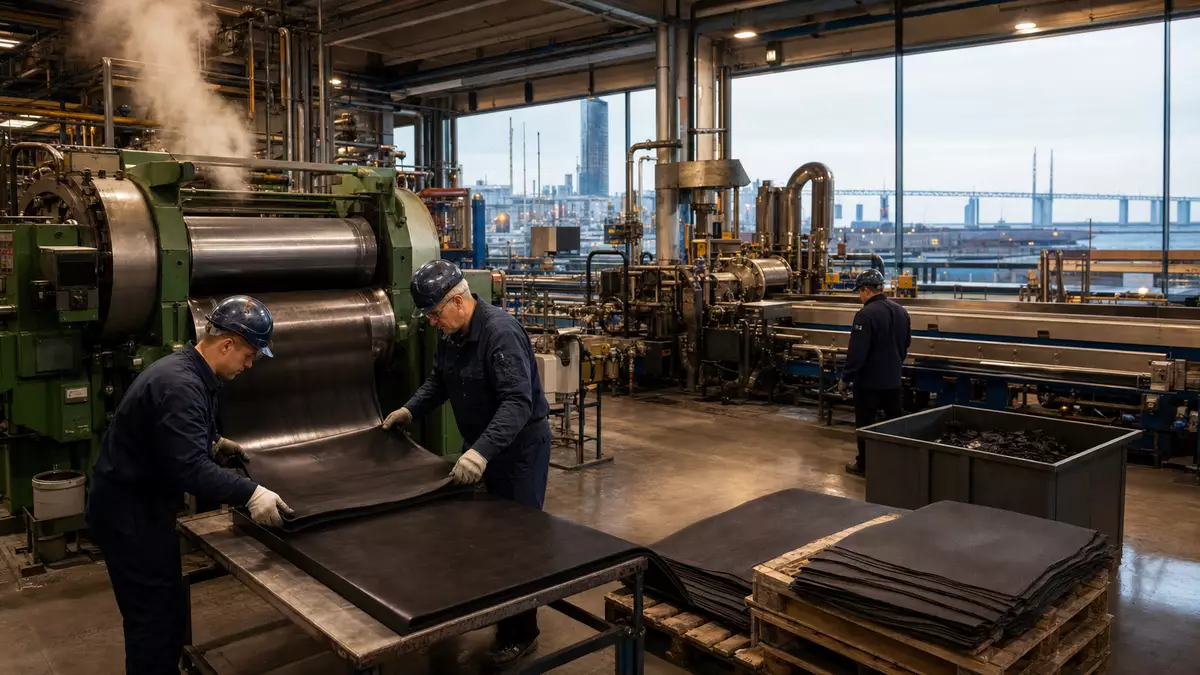
Hexpol AB (ISIN SE0011624077) stock is trading steadily in August 2026, with the shares reflecting a calm valuation backdrop as investors look ahead to the company’s next earnings update and monitor its positioning among Nordic industrial peers.
Recent market data as of August 20, 2026 shows the Hexpol share price quoted at 89.70 SEK, indicating a stable level with no change over the latest five-day period and no movement since the start of the year, underscoring how the stock is currently consolidating rather than moving sharply in either direction.
This static price over the recent window means that Hexpol’s equity valuation is being driven more by expectations for upcoming financial results and long-term demand for polymer and rubber compounding solutions than by short-term trading swings.
Stable share price amid muted short-term moves
The most recent quote snapshot for Hexpol indicates a last close of 89.70 SEK as of August 20, 2026, with the five-day performance showing a 0.00 percent change and the year-to-date change also at 0.00 percent, pointing to a period of unusual stability for an industrial supplier exposed to cyclical end markets.
For investors, this flat performance over both the weekly and year-to-date horizons is notable because it contrasts with the more volatile patterns seen in broader equity markets in August 2026, and suggests that Hexpol’s valuation is anchored by expectations for steady cash flows rather than momentum-driven trading.
The current price level around the high 80s in SEK sits below typical 52-week highs reported for Nordic industrial stocks during stronger phases of the cycle, indicating that while Hexpol is not under severe pressure, there is room for the shares to re-rate higher if upcoming results and guidance confirm a resilient earnings trajectory.
Interpreting fundamentals through sector comparison
While the latest detailed quarterly figures for Hexpol are not fully visible in the recent quote snapshot, sector-comparison tools show the company’s metrics alongside other Nordic industrial names, highlighting the importance of margins and growth in evaluating the stock’s relative attractiveness.
Historically, Hexpol has reported solid revenue and operating profit from its polymer and rubber compounding business, with fiscal year results in prior periods showing sales in the multi-billion SEK range and operating margins in double digits, underlining how the company has built a reputation for disciplined cost control and niche-market focus.
For context, if Hexpol’s latest quarter maintains revenue near historic levels and keeps operating margin in a similar double-digit band, the current share price around 89.70 SEK would imply a valuation that is broadly in line with other Nordic industrial suppliers, neither at a deep discount nor at a stretched premium.
Investors therefore pay close attention to any changes in Hexpol’s quarterly revenue growth rate or margin profile, because even a shift of 2 to 3 percentage points in margin or a mid-single-digit change in year-over-year sales can have a noticeable impact on earnings per share and, in turn, on the stock’s implied price-to-earnings ratio.
In this context, sector-comparison data that places Hexpol alongside other industrial names with similar ratings gives investors a practical benchmark to see how the company’s profitability and growth stack up against peers, which can influence portfolio allocation decisions in Nordic and European small- and mid-cap industrial indices.
Guidance, consensus and investor expectations
Ahead of the upcoming earnings season, the key question for Hexpol watchers is whether the company will reiterate or adjust its outlook for demand across automotive, construction, and general industry end markets, and how that will filter through to revenue guidance and margin expectations for the rest of 2026.
Consensus estimates compiled by market-data services typically track expectations for Hexpol’s revenue growth and earnings per share over the coming quarters, and shifts in these estimates can create quantified comparisons that investors use to gauge whether the shares are priced for an upside or downside surprise.
For example, if consensus revenue for the next reported quarter is set at a mid-single-digit increase versus the prior-year period, any reported figure that comes in 2 or 3 percentage points above that expectation would be interpreted as a beat, supporting a positive reaction in the stock; conversely, a shortfall of similar magnitude versus consensus could weigh on the valuation.
Similarly, investors compare Hexpol’s expected and reported operating margin against its own historical averages and peer group data, so that a margin print that is 1 to 2 percentage points stronger than the prior year can signal improving efficiency and pricing power, while a decline of comparable magnitude may raise questions around input costs or competitive pressure.
Given the calm share-price behavior in August 2026, the market appears to be in a waiting mode, holding Hexpol at a level where the valuation can move in either direction once new guidance or results provide concrete numbers to update earnings models and relative-value screens.
Operational backdrop for polymer and rubber solutions
Hexpol’s core business revolves around supplying advanced polymer and rubber compounds used in a wide range of applications, from automotive seals and hoses to building materials and industrial components, giving the company diversified exposure to global manufacturing trends.
The company’s operational performance is influenced by volume trends in these end markets, pricing for raw materials such as synthetic rubber and additives, and the mix of higher-value specialty compounds versus more commoditized products.
When Hexpol increases the share of specialty and customized compounds in its sales mix, it can often support higher margins and more stable customer relationships, while a tilt toward lower-margin commodity volumes tends to expose earnings more to raw-material price swings and competitive pricing pressure.
In recent years, Hexpol has highlighted initiatives to focus on innovation and sustainability in its product offering, such as developing compounds that support lighter-weight components, improved durability, and better recyclability, which can position the company favorably with customers that prioritize environmental performance and lifecycle cost savings.
Investors watching the stock in August 2026 therefore consider not only headline revenue and profit figures, but also qualitative indicators of how Hexpol is evolving its product portfolio, as this can influence long-term growth potential and the company’s ability to defend margins in more competitive phases of the cycle.
Representative product: high-performance rubber compounding
A representative example of Hexpol’s business is its high-performance rubber compounding solutions, which are used to produce seals, gaskets, hoses, and other components that must withstand mechanical stress, temperature variations, and exposure to chemicals in automotive and industrial environments.
These compounds are formulated to meet specific customer requirements, such as resistance to oil and fuel, flexibility at low temperatures, or durability under repeated compression, and Hexpol works closely with original equipment manufacturers and tier suppliers to tailor the composition of rubber mixtures to the end-use application.
By offering a broad portfolio of rubber compounds and related services, including mixing, testing, and quality assurance, Hexpol can capture value along the supply chain and differentiate itself from competitors that focus mainly on standard formulations.
The performance of this product segment feeds directly into Hexpol’s fundamentals, as demand for high-performance rubber compounds translates into volumes, while the complexity and customization of formulations can support better pricing and margin levels than more basic products.
Calm price picture as of the latest close
As of the latest completed trading session on August 20, 2026, Hexpol’s shares closed at 89.70 SEK on their home market, reflecting a period of calm for the stock with no recorded change over the recent five-day window and an unchanged level since the start of the year.
This mix of steady price action and awaiting new financial data means that Hexpol stock currently offers investors a relatively stable exposure to polymer and rubber compounding, with the potential for revaluation once upcoming earnings and guidance updates provide fresh figures on revenue trends, margins, and cash flow.
In this environment, investors who follow Hexpol closely continue to compare the company’s operational progress and sector standing against peers in Nordic industrial indices, ready to adjust their view as soon as the next set of numbers clarifies whether the current consolidation phase in the share price will give way to a more directional move.
Fact box
Company: Hexpol AB
ISIN: SE0011624077
Ticker: HEXPOL
Exchange: Nasdaq Stockholm
Price (as of August 20, 2026, close): 89.70 SEK
Sector / Industry: Materials - Specialty chemicals and polymer compounding
Index membership: Nordic industrial indices


