
Applied Materials stock holds near $480 as AI-driven Q3 results lift guidance
Published on 08/28/2026 at 07:46 | Editorial responsibility: Rafael Müller, Editor-in-Chief AD HOC NEWS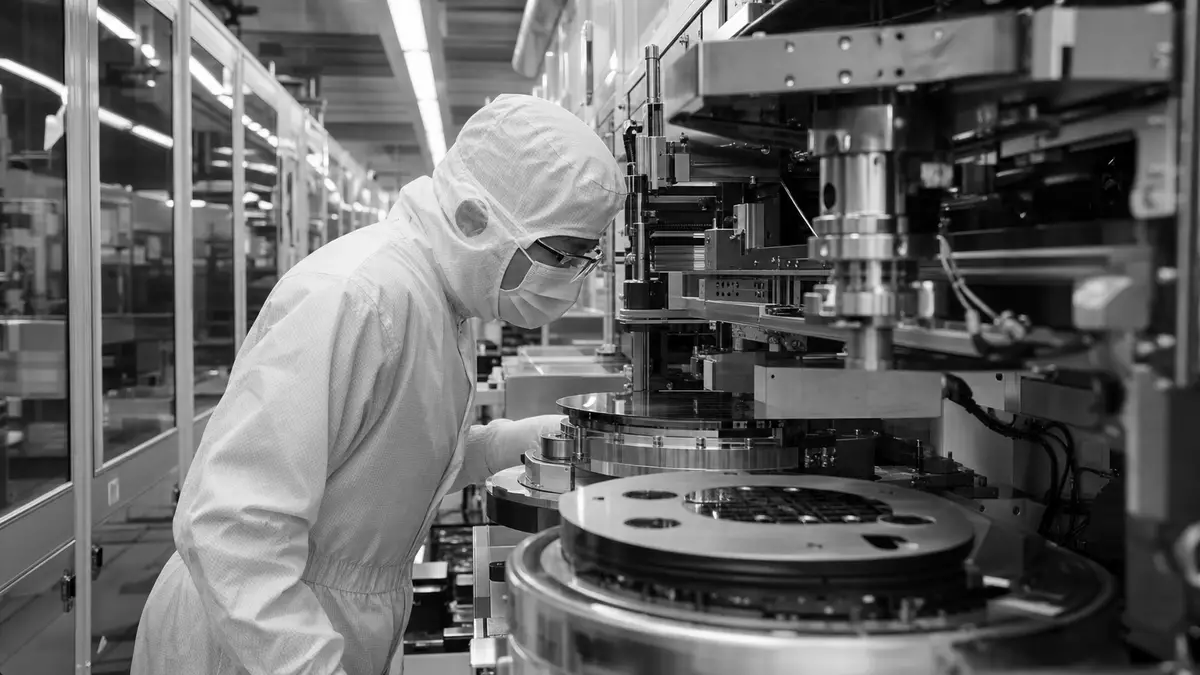
Applied Materials Inc. (US0382221051) stock is trading close to $480 as of August 27, 2026, following record fiscal third-quarter 2026 results that underscored how AI infrastructure spending is reshaping the company’s growth trajectory. Per recent earnings coverage dated August 26, 2026, the semiconductor equipment maker reported new highs in revenue and earnings and guided to another strong quarter, giving investors a clearer picture of how fast demand is building in advanced wafer fabrication tools.
Record Q3 revenue and EPS underscore AI demand
According to a detailed earnings overview of Applied Materials’ latest results discussion, the company delivered fiscal Q3 2026 revenue of $9.12 billion, representing year-over-year growth of 25 percent as demand for wafer fabrication tools tied to AI and advanced logic remained strong. This earnings recap highlights that in the same quarter, non-GAAP earnings per share reached $3.50, while GAAP EPS came in at $3.17, providing clear leverage on the top-line gain as profitability scaled with volume.
Further details from the same results commentary show that fiscal Q3 2026 marked Applied Materials’ 13th consecutive quarter of year-over-year gross margin expansion, with gross margin above 50 percent. The overview notes that the higher mix of advanced-node tools and services supported profitability, with adjusted operating margin rising to around 34 percent compared with roughly 30.7 percent one year earlier, and adjusted operating income increasing 38 percent to $3.10 billion. A separate report on the quarter indicates that the company’s revenue of $9.12 billion exceeded analyst expectations of $8.99 billion and was up 24.8 percent compared with the prior-year period, while non-GAAP EPS of $3.50 beat the consensus estimate of $3.40 by $0.10, reinforcing the impression that AI-related demand is running ahead of prior forecasts.
Q4 2026 guidance points to another step-up
The Q3 2026 earnings recap also sets out Applied Materials’ outlook for the fiscal fourth quarter of 2026, where management forecast revenue of $10.25 billion. The same guidance discussion notes that this level would represent a sequential revenue increase of $1.13 billion compared with the Q3 figure of $9.12 billion and implies year-over-year growth of 51 percent in Q4, an acceleration from the 25 percent growth just posted. In terms of earnings, management projected non-GAAP EPS of $4.02 for fiscal Q4 2026, which would represent 85 percent growth versus the prior-year quarter, indicating that margins are expected to remain strong even as volumes rise.
Additional analyst-focused coverage of the latest quarter adds more color to how guidance was framed. One summary of the Q3 2026 report explains that Applied Materials has set its Q4 2026 EPS guidance range at $3.82 to $4.22. Within that span, the $4.02 midpoint aligns with management’s forecast cited in the earnings recap and sits distinctly above the earnings analysts had modeled before the report, which were characterized as roughly $3.69 per share. The same overview points out that the company’s net margin in the latest quarter was 30.05 percent and that return on equity stood at 38.02 percent, metrics that place Applied Materials among the more profitable names in the semiconductor manufacturing equipment space at a time when AI-related capital expenditure is expanding across leading chipmakers.
Valuation and stock reaction around the results
A market-focused article on the AI buildout’s impact on Applied Materials interprets these numbers through the lens of valuation. That analysis notes that as of August 27, 2026, investors were paying a forward price-to-earnings multiple of 27.17 for Applied Materials’ growth profile, a valuation that the piece argues only makes sense if the current AI-driven capacity boom continues to compound instead of flattening. In other words, the stock’s premium rests on the expectation that wafer fabrication demand for AI chips, advanced logic, and memory will remain strong enough to support double-digit revenue increases and ongoing margin expansion over several more quarters.
Another commentary on the earnings reaction stresses that despite the company posting record quarterly revenue and profit, the shares declined by about 5.1 percent in the subsequent trading session. That discussion attributes the drop more to elevated expectations than to any weakness in the report itself, suggesting that after a rapid rise in the share price ahead of the earnings release, some investors took profits when the actual numbers, although strong, failed to deliver an upside surprise commensurate with the run-up. The analysis underscores that Q3 2026 revenue of $9.115 billion—quoted there with slightly finer precision than the $9.12 billion figure in other sources—still marked a historic high for the company and came in well above the $8.99 billion level that Wall Street had penciled in, yet the stock’s move illustrates how sentiment can depend as much on prior positioning as on the reported data.
In addition to the core results and guidance, recent institutional activity around Applied Materials reflects ongoing interest from large investors. Several filings summarized in market data reports describe fund managers adjusting their positions, with one update highlighting that Applied Materials’ shares comprise multi-million-dollar stakes in certain portfolios. These summaries reiterate the Q3 2026 headline figures of $3.50 EPS and $9.12 billion in revenue, emphasize that the quarter’s revenue growth of 24.8 percent year over year outpaced broader semiconductor capital spending trends, and note that analysts maintain a consensus rating characterized as “Moderate Buy” with an average price target of $657.76. Taken together, those elements frame a picture in which the stock is viewed favorably but is also exposed to valuation risk and regulatory considerations, including export-control developments related to China.
Same-day trading context and price levels
Fresh price data from a major stock-quote service shows that Applied Materials’ U.S.-listed shares on Nasdaq traded at $479.50 at 7:59 p.m. ET on August 27, 2026, representing a decline of $2.86 or 0.59 percent for that session. The same quote history indicates that the prior close in the regular session was $482.36, which itself reflected a gain of $2.60 or 0.54 percent, implying that the stock had moved higher before easing somewhat later in the day. A separate technical quote on a tokenized representation of Applied Materials in USD shows a value of 480.78 with a daily change of -6.45 and a percentage move of -0.75 percent, illustrating that related instruments tied to the company’s equity also experienced modest selling pressure over that short window.
Sector commentary on August 28, 2026 adds context by noting that several large U.S. semiconductor names posted gains of more than 3 percent, while other chip and equipment stocks, including Applied Materials, saw declines. In that market overview, Broadcom and Intel were cited as moving higher by more than 3 percent, whereas AMD, Micron, and Applied Materials were described as slipping, indicating that the day’s trading pattern reflected rotation within the broader AI and semiconductor complex rather than a uniform trend. For investors, this backdrop matters because it suggests that even companies delivering record quarters can see their shares fluctuate in step with changing sentiment across the sector, especially when valuation premiums are elevated.
Cash generation, capital returns, and dividend profile
The detailed Q3 2026 earnings breakdown also highlights Applied Materials’ cash generation and capital return strategy. One analysis notes that the company generated record operating cash flow of $3.04 billion in the quarter and free cash flow of $2.33 billion, figures that demonstrate strong conversion of earnings into cash. The same commentary reports that Applied Materials returned $860 million to shareholders during the quarter, with $440 million delivered through share repurchases and $420 million via dividends, indicating a balanced approach that combines buybacks with a cash payout.
Recent dividend-focused summaries reiterate that the company declared a quarterly dividend of $0.53 per share, set to be paid on September 10, with investors of record on August 20 qualifying for the distribution. Those pieces calculate that this dividend level translates into an annualized payout of $2.12 per share and a yield of 0.4 percent based on the prevailing share price, underscoring that Applied Materials remains primarily a growth-orientated equity where capital appreciation is expected to be the main return driver, with the dividend serving as a modest supplementary income stream. The dividend announcement appears alongside the Q3 results discussion, reinforcing that management is continuing to return cash even as it invests heavily in capacity to meet AI-related demand.
AI buildout and long-term return profile
A long-horizon performance snapshot brings the AI story into perspective. One retrospective calculation shows that a $1,000 investment in Applied Materials made in August 2016 would be worth $16,008.01 as of August 27, 2026, implying a gain of 1,500.80 percent over the decade. The same analysis compares this result with major indices, indicating that the stock has substantially outperformed broader benchmarks during that period, in part because the company has positioned itself at the center of structural trends in semiconductor manufacturing, including the rise of AI, data centers, and advanced lithography.
Macro-focused commentary from market strategists reinforces that AI-related demand is expected to remain a central theme for the semiconductor value chain. A pre-market report on August 28, 2026 notes that strong results and guidance from leading AI chip companies have set a positive tone for the broader sector, with AI supply chain names and electronic materials groups likely to remain under active consideration by investors. For Applied Materials, this means that the company’s exposure to leading-edge manufacturing nodes and its installed base of process tools positions it to benefit as chipmakers expand capacity for AI accelerators, advanced logic, and memory, even as cyclical dynamics in other segments, such as smartphones or PCs, ebb and flow.
Representative product: wafer fabrication systems for advanced nodes
A representative example of Applied Materials’ business is its portfolio of wafer fabrication systems designed for advanced process nodes used in AI chips and high-performance logic. Industry coverage explains that these tools encompass deposition, etch, inspection, and metrology equipment that enable chipmakers to pattern ever-smaller features with high precision and yield. In practice, this means that complex stacks of materials are laid down and removed layer by layer on silicon wafers, with Applied Materials’ systems controlling critical variables such as film thickness, uniformity, and defect rates.
AI workloads, which require dense arrays of transistors and high-bandwidth memory, are pushing manufacturers toward leading-edge geometries, making process control and materials engineering increasingly important. Applied Materials’ products in areas such as chemical vapor deposition, physical vapor deposition, and atomic layer deposition are highlighted in sector analyses as key enablers of these advanced structures. By supplying integrated solutions that combine hardware, software, and services, the company seeks not only to sell initial systems but also to capture ongoing revenue from upgrades, maintenance, and optimization as fabs tune their lines for higher throughput and efficiency.
Applied Materials stock and investor view
Applied Materials stock, traded on Nasdaq under the ticker AMAT, closed at $482.36 in the most recent regular U.S. trading session prior to 7:59 p.m. ET on August 27, 2026, before later prints showed the shares at $479.50, both in USD. The current valuation, framed by a forward P/E of 27.17 and supported by record fiscal Q3 2026 revenue of $9.12 billion and guided Q4 revenue of $10.25 billion, leaves investors weighing strong, AI-driven growth and expanding margins against the risks that elevated expectations and regulatory developments pose. For many, the key question is whether the company can continue to translate the AI buildout into sustained double-digit revenue growth and robust cash generation, thereby justifying the stock’s premium and supporting further long-term gains.
Fact box
Company: Applied Materials Inc.
ISIN: US0382221051
Ticker: AMAT
Exchange: Nasdaq
Price (as of August 27, 2026, 7:59 p.m. ET): $479.50 USD
Market cap: Not specified in the cited price snapshot
Sector / Industry: Semiconductors / Semiconductor equipment
Index membership: S&P 500


